An older home in Lowell does not automatically need complete rewiring. Its wiring condition, alterations, protective equipment, and intended electrical loads should shape the recommendation. Begin with an assessment and relevant records, then compare repair and replacement scopes based on what is actually found.
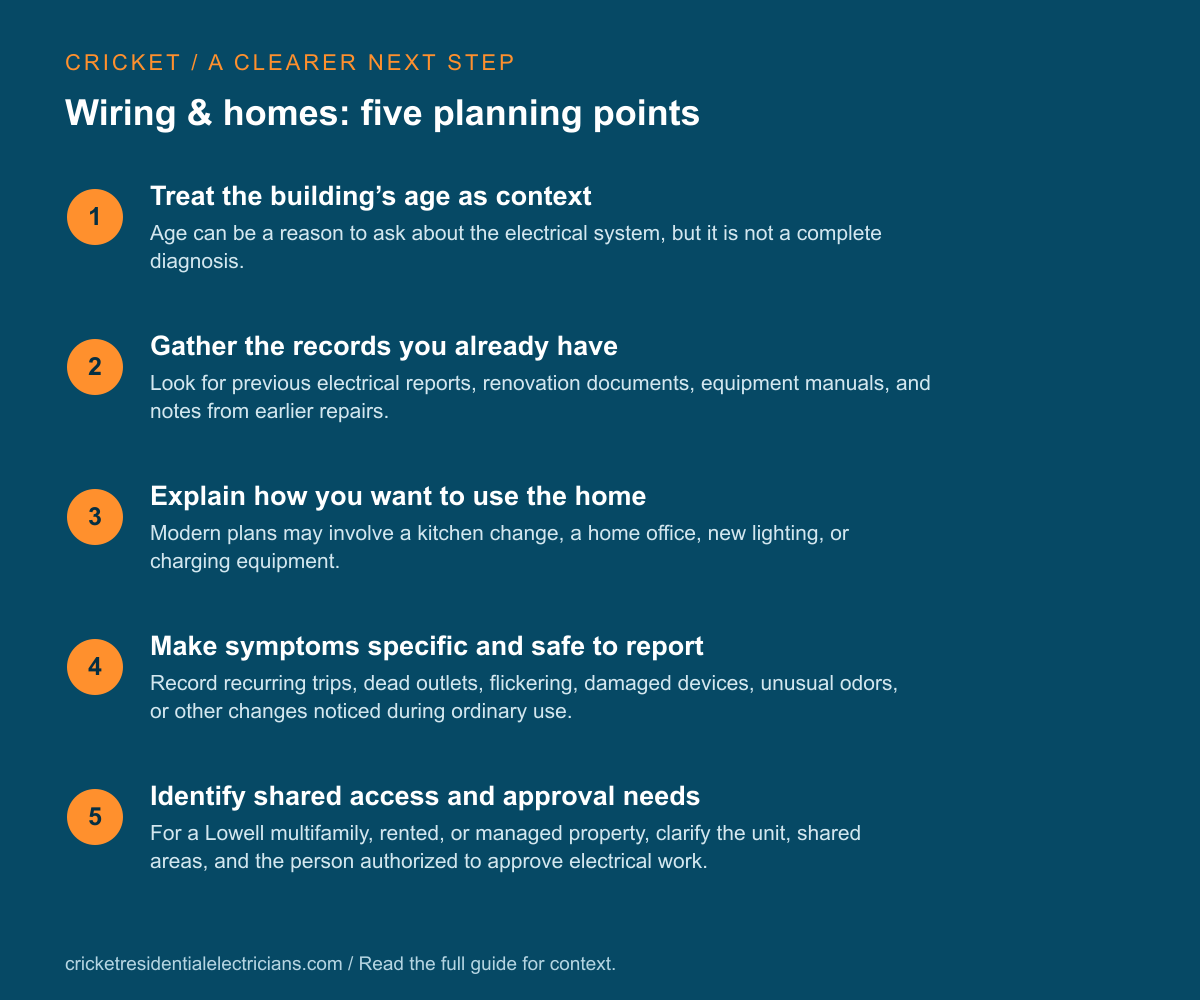
Treat the building's age as context
Age can be a reason to ask about the electrical system, but it is not a complete diagnosis. A home may contain original work, later additions, replaced equipment, and undocumented changes. The visible finish of a room does not reveal every concealed circuit. Tell the electrician what you know and where the history is uncertain. A useful assessment connects recommendations to actual findings and intended use. Avoid assuming that every older Lowell property has identical wiring or that a recent renovation establishes the condition of the whole installation. The property needs to be understood on its own terms.
Gather the records you already have
Look for previous electrical reports, renovation documents, equipment manuals, and notes from earlier repairs. Keep these together without altering electrical equipment to obtain more detail. If you are buying the property, explain what a home inspector has identified and what clarification you need from an electrician. A private condition assessment and an authority inspection have different purposes, so confirm the expected service and documentation. Missing records are information to share, not a reason to invent a history. An electrician can explain what can be assessed and where concealed conditions limit the initial conclusions.
Explain how you want to use the home
Modern plans may involve a kitchen change, a home office, new lighting, or charging equipment. Tell the office about foreseeable additions as well as present symptoms. A home that works for its current routine may need a different arrangement for substantial new loads. More outlets alone do not create more circuit capacity. Conversely, one unreliable device does not prove a whole house rewiring project is necessary. Describe the goal and ask which assessment findings support the proposed work. This keeps the conversation focused on function and condition rather than treating the building's age as the only decision factor.
Make symptoms specific and safe to report
Record recurring trips, dead outlets, flickering, damaged devices, unusual odors, or other changes noticed during ordinary use. Say when they occur and which rooms or equipment are involved. Stop using damaged electrical equipment and keep away from exposed connections. Do not remove covers or disturb unfamiliar wiring for photographs. The Electrical Safety Foundation's home system information explains why wiring and protective equipment need appropriate attention, but a website cannot identify your installation from a symptom alone. Call 911 for fire, smoke, injury, or immediate danger rather than waiting for a routine assessment appointment.
Identify shared access and approval needs
For a Lowell multifamily, rented, or managed property, clarify the unit, shared areas, and the person authorized to approve electrical work. A panel or circuit may serve areas beyond one room, so explain the arrangement if known. Coordinate access through the responsible owner or manager and discuss any tenant notices that may be needed. Do not assume every electrical component is accessible from the unit requesting service. These details can affect the visit and scope. They should be part of the initial conversation rather than becoming an unexpected obstacle after equipment or materials have already been ordered.
Understand the limits of a first assessment
Finished walls, inaccessible spaces, stored items, and concealed alterations may limit what can be reviewed without further work. Ask which areas were assessed and which remain uncertain. A useful report distinguishes observations from assumptions and identifies follow up where needed. The initial visit may support a targeted repair, a more detailed investigation, or planning for broader changes. None of those outcomes should be treated as a permanent guarantee covering every concealed component. Keep the limits in the record so later decisions use the same understanding instead of silently expanding the meaning of an earlier inspection.
Compare a repair with a rewiring scope
A targeted repair addresses a defined problem, while rewiring changes a larger part of the installation. Ask which rooms, circuits, devices, and protective equipment are included in each proposal. Discuss why the recommended boundary fits the findings and future needs. A broad scope should identify access assumptions and what happens if concealed conditions differ from expectations. A narrow scope should make its limitations clear. The right comparison is between complete proposals for the same need, not simply two totals that include different work. Ask for clarification before assuming a larger or smaller project is automatically the appropriate choice.
Ask about disruption before agreeing to dates
Wiring access can affect finished surfaces, occupied rooms, attics, basements, or other areas of the building. Ask where openings may be needed and who handles restoration. Discuss whether work can be phased, which circuits will be interrupted, and how the home can be used during the project. Identify equipment that needs advance coordination before a shutdown. Confirm materials, access, permit arrangements, and inspection responsibilities where relevant. A start date is more useful when the scope and practical conditions are understood. Avoid treating a general office opening schedule as proof that a particular project can be completed immediately.
Keep the finished work understandable
After a repair or wiring project, ask what was completed, what was tested, and whether any follow up remains. Retain the relevant documentation and equipment information. If a symptom returns, explain whether it affects the same area and share the earlier findings. Future contractors and property contacts benefit from a clear record of changes rather than a vague statement that the electrical system was updated. Keep recommendations and exclusions together. This makes it easier to distinguish completed work from an improvement that was discussed but never authorized, which matters when planning another renovation or reviewing the condition later.
Contact the Lowell office with a clear request
Cricket Residential Electricians in Lowell uses (978) 209-8900. The supplied Google profile publishes 453 Pawtucket Street, unit 1, Lowell, MA 01854; call before arranging an office visit. Give the property ZIP code, building type, reason for the assessment, and available records. Explain whether the request concerns a fault, purchase report, or planned improvement. The local office can confirm coverage, accepted work, and current availability. Starting with these details helps the next step address your home's actual conditions, with repair or rewiring decisions grounded in the assessment rather than an assumption about every older building.