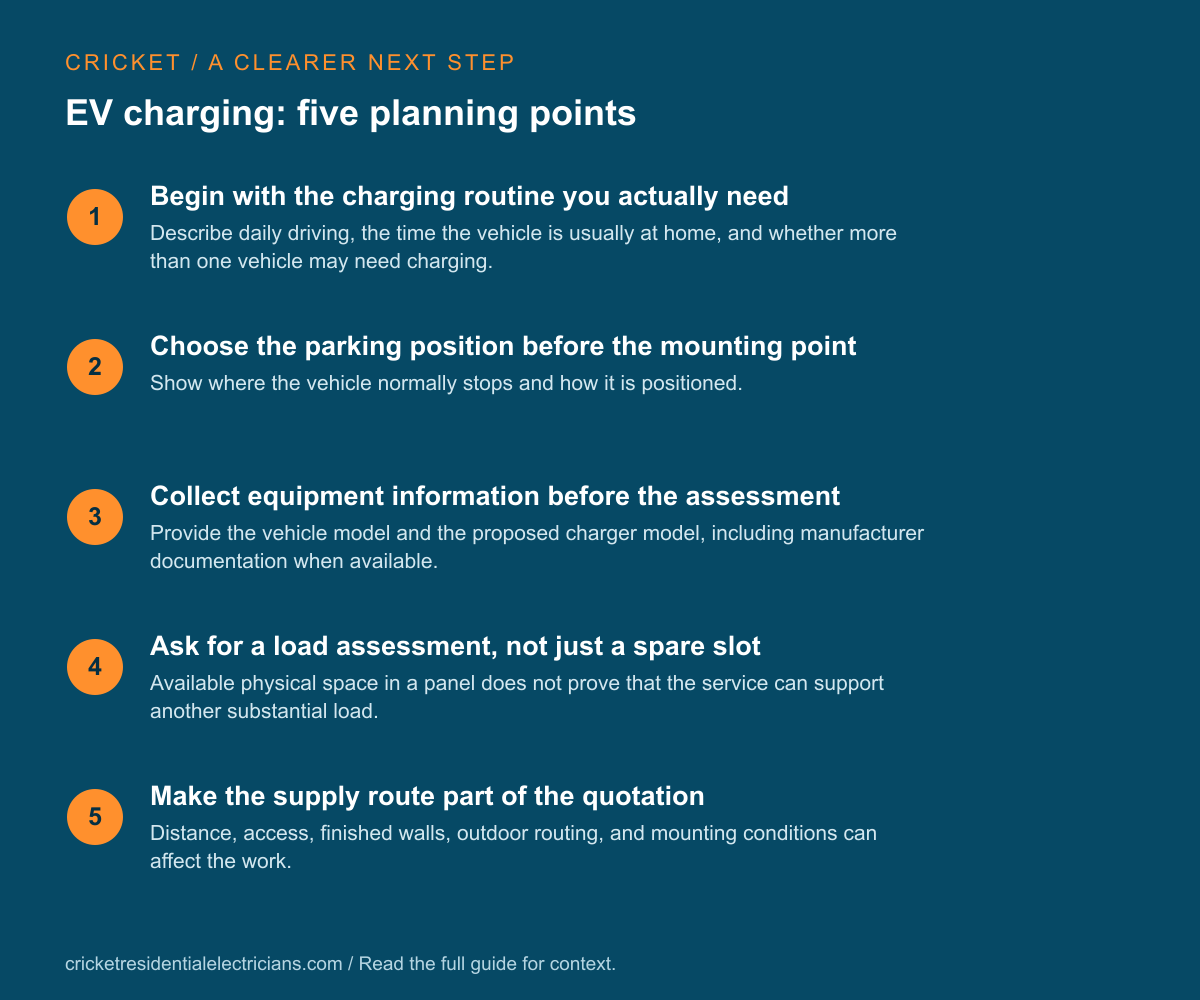
Plan a home EV charger by matching your driving routine and parking location to suitable equipment and an assessed electrical supply. A charger purchase does not establish that the home can support its full rating. Have the installation evaluated before choosing the final circuit, location, and equipment settings.
Begin with the charging routine you actually need
Describe daily driving, the time the vehicle is usually at home, and whether more than one vehicle may need charging. Those details help frame a practical solution. The highest available charger rating is not automatically the best answer for every household, and a product advertised for a particular power level does not establish the charging speed of every vehicle. Make a short list of your present routine and foreseeable changes. Keep it separate from claims about an exact charging time until the vehicle, equipment, settings, and electrical installation have been considered together.
Choose the parking position before the mounting point
Show where the vehicle normally stops and how it is positioned. Consider the charge port location, the space needed to move around the vehicle, and a cable route that avoids an unsuitable crossing or trip hazard. A wall with space for a unit may still be inconvenient for everyday use. Mention garage doors, storage, gates, walkways, and outdoor exposure. The site assessment should look at the practical route between the electrical supply and charging location, rather than assuming the shortest visible distance tells the whole story. Product mounting and cable instructions also matter.
Collect equipment information before the assessment
Provide the vehicle model and the proposed charger model, including manufacturer documentation when available. Tell the office whether the unit has already been purchased and whether it is intended for indoor or outdoor use. Some products have specific mounting, protection, connectivity, or operating requirements. A photograph of the box is less useful than the actual model information. Do not order extra electrical components based on an online example installation. The electrician needs to consider the actual property and compatible arrangement before defining the circuit and protective equipment. Keep installation instructions available until the project is complete.
Ask for a load assessment, not just a spare slot
Available physical space in a panel does not prove that the service can support another substantial load. Existing demand and the proposed charging arrangement need to be considered. Explain other major equipment and future plans, such as a remodel or another electrical addition. Ask what assessment is required and which options follow from it. A panel or service upgrade may be part of the answer, but it is not an automatic requirement for every charger. Suitable circuit options or compatible load management can also be questions for the electrician, depending on the installation.
Make the supply route part of the quotation
Distance, access, finished walls, outdoor routing, and mounting conditions can affect the work. Ask which route is assumed and whether openings, trenching, or surface repairs are included. A quotation for a short accessible run is different from a proposal that crosses finished areas or a detached structure. Clarify who supplies the charging unit, which model the quote assumes, and whether commissioning is included. If a change is needed during work, ask how it will be approved. Comparing complete scopes helps avoid mistaking different installation boundaries for different prices for an identical job.
Keep electrical work and software setup distinct
Some charging equipment uses an app, network connection, or schedule. Discuss these features if they are important to your routine, but ask what the electrical installer's scope includes. Wi Fi performance, vehicle software, subscriptions, and utility account services can involve separate providers. Do not rely on an assumption that every advertised smart feature will be configured by the electrician. Keep account access and passwords out of the initial website inquiry. Once the equipment is installed, review the agreed operating settings and retain the relevant manufacturer support information for software questions or future changes.
Follow charging safety instructions in normal use
The Electrical Safety Foundation recommends manufacturer approved charging cables, inspection for visible damage, and installation by a qualified electrician. Its guidance warns against using extension cords or multiplug adapters for EV charging. Keep these points in the everyday routine after the project is finished. Store the cable so it is not damaged or driven over, and stop using visibly damaged charging equipment. Outdoor use must follow the equipment's instructions and the installation arrangement. A professionally planned installation is not a reason to ignore later damage, water exposure, or protective trips.
Clarify permits, inspections, and downtime
Ask who determines and coordinates any required permits and inspections for the specific work. The answer depends on the property and installation, so confirm it with the responsible professional instead of relying on a generic checklist from another market. Discuss access to the electrical equipment and any planned interruption to the home. If utility coordination is needed, ask which party arranges it and how that affects scheduling. A purchase date or office opening hours does not establish a completed installation date. Keep the appointment, approval process, and inspection responsibilities explicit in the agreed scope.
Review the installation before relying on it
Ask the electrician to explain the equipment installed, charging settings, accessible user controls, and any limitations or follow up. Keep documentation for the circuit and product together. If a protective device trips or charging behaves unexpectedly, describe the conditions and contact the appropriate professional or manufacturer instead of repeatedly trying to force operation. A successful initial charging session is useful, but it does not establish a promise about every future charging time or electricity bill. Changes to the vehicle or equipment should be reviewed against the installation rather than assumed to be interchangeable.
Use the local office to confirm the next step
Cricket accepts EV charging inquiries through its Phoenix, Lowell, San Antonio, and Spicewood contacts. Provide the service ZIP code, property type, parking location, and vehicle and charger details. Explain if you rent, share a parking area, or need approval from a property manager. The office can confirm coverage, accepted work, and what an assessment needs. Start with these facts before buying an upgrade package based on another homeowner's installation. The aim is a charging arrangement that fits the property and the way you drive, with its electrical requirements and responsibilities understood before work begins.